
4 Creative Ways To Sell Products Without An Online Store

Are you interested in selling products online but don’t want to go through with building and managing an online store?
Ecommerce has come a long way. There are a lot of different ways to build an online store, but there are also plenty of ways to get by without one.
In this post, we take a look at the benefits and drawbacks of selling products online without an online store before focusing on methods entrepreneurs and influencers use to do just that.
Why influencers aren’t building dedicated ecommerce sites
Websites in general aren’t very popular among influencers.
In their eyes, because they upload all of their content to social media platforms, they have no reason to try and build an audience from a domain that’s separate from social media.
Now that social commerce and other ecommerce solutions have become more prevalent, influencers have the same attitudes toward ecommerce websites.
We’ll talk more about these methods in a bit, but platforms like Etsy and the launch of TikTok Shop have made it easier and more cost effective for creators to become profitable without sending customers to websites they operate themselves.
What are the advantages of selling products without an online store?
These are the advantages of selling products without building a full-fledged ecommerce site:
- Cheaper
- Easier to set up
- Less technical
- No website to manage
- Customers don’t have to leave the app to buy products you promote
Let’s talk about each one briefly.
Cost
Setting up and managing an ecommerce site is a pretty complex undertaking, even with an ecommerce platform.
You have to pay for hosting, which is an ongoing fee you either have to pay monthly or annually.
You might also need to spend extra on a website theme if you don’t like the ones your platform offers for free.
Some platforms even have third-party apps and plugins you need to purchase separately in order to add a certain functionality to your site.
When you sell products on social media or a marketplace, you only need to pay a seller fee when you make a sale.
Setup
After you purchase a hosting plan from an ecommerce platform, you need to install a theme, customize that theme, build pages and more in order to set your website up properly.
When you sell products on an established marketplace, you only need to create a store and add products to it.
The marketplace takes care of hosting, and it has a set design that all stores use.
Technicalities
It’s never been easier to build a website, but that doesn’t mean it isn’t still technical.
You need to establish a domain, build the website, worry about SEO, set up payment gateways, define shipping settings and more.
You don’t have a proper domain when you sell through a marketplace, and the marketplace has set systems in place for payments and shipping that everyone is required to use.
This means you don’t have to do anything to get your store up and running.
Management
Managing an ecommerce website doesn’t stop just because you’ve launched it.
This is especially true if you use a third-party theme and third-party apps.
You need to monitor your store everyday to ensure it remains secure and functional.
Your ecommerce platform may be able to coach you through some issues, but for the most part, you’ll need to manage everything yourself.
Promotion
This one’s really only an advantage if you sell on social media. This is because selling products on social media removes a few steps from a typical sales funnel.
A typical sales funnel requires a potential customer to leave a promotion channel in order to complete the sale on your website. This sometimes involves a few extra steps if you want to acquire them as a lead first.
If you sell products on your promotion channel, such as a social media platform, you can promote a product in your video, then link to that product directly in the video itself.
Your customer won’t need to leave the app to complete their purchase. They can pay for their order, then get right back to their feed.
What are the disadvantages of selling products without an online store?
Selling products through marketplaces you don’t manage yourself is convenient, but that convenience comes at a price.
Here are a few disadvantages of selling products without an online store:
- Seller fees
- Little control over your store
- Limited by functionalities your chosen marketplace offers
Let’s talk about these disadvantages.
Seller fees
It might seem cheaper not to have to pay monthly hosting fees, but in reality, marketplaces come with an even heavier price in the form of seller fees.
A seller fee is a commission a marketplace deducts from every sale you make with them.
For example, many sellers report TikTok Shop’s seller fees as being between 6 and 8%.
This means if you make a sale of $30, TikTok Shop takes between $1.80 and $2.40 from it.
That doesn’t seem like much, right?
Well, let’s say you make 200 sales from that $30 product, which works out to a total of $6,000. TikTop will take between $360 and $480 of that.
In contrast, an ecommerce platform like Sellfy costs $29/month for the plan that allows you to process as many as 10,000 sales per month but charges no transaction fees.
You only need to pay the processing fees that PayPal and Stripe charge, which Sellfy has no control over.
No control
Selling products through a marketplace or social media is fine for the most part, but there may come a time when you start to notice how little control you have over key aspects of your business.
This is especially true in the case of seller fees. There’s not much you can do if the marketplace you use decides to raise their fees.
You might also get frustrated with how your preferred marketplace emails customers, particularly in how they handle order status updates.
If you run your own online store, you can customize little things like order confirmation emails and abandoned cart emails.
Sellfy even offers email marketing natively within its platform.
Marketplace limitations
Finally, marketplace solutions are far more limiting than dedicated ecommerce websites.
For example, TikTok Shop has a set design.
You can add your own text and images to product pages, but you can’t change its overall design to optimize your conversions.
Every other page within TikTok Shop will also be cluttered with products from other stores.
If you build your own online store, you can dedicate each and every page to your own products.
You also have to use whatever payment gateways the marketplace uses.
If you use an ecommerce platform, you normally have a couple more options to choose from.
The same goes for shipping and marketing capabilities. It’s very easy to weave your email marketing strategy into your ecommerce strategy when you sell products from your own website.
Should you use multiple sales channels?
Do you really have to choose one or the other?
If you launch an online store, are you not able to sell products on TikTok Shop? If you sell through TikTok Shop, are you not able to build your own website as well?
In truth, it’s probably best to use both. That way, you have multiple sales channels to rely on in case one falters.
Just be sure to promote each sales channel properly. Don’t assume customers know about each.
If you have to choose one to focus on, go with a dedicated online store built with a platform like Sellfy.
You’ll have more management options to choose from and more design options, and you won’t have to deal with seller fees.
4 ways to sell products without an online store
These are the best ways to get started with ecommerce without building an online store:
- Social commerce – Selling directly on social media platforms that have ecommerce features built in
- Live shopping – Selling directly on livestreaming platforms that allow customers to make direct purchases
- Online marketplaces – Marketplaces that are set up for peer-to-peer online transactions or designed to host thousands of stores
- Email list – Use your email list to sell digital products to subscribers directly without the need for a dedicated online store
Let’s talk more about these solutions.
1. Social commerce
Social commerce is a growing trend in ecommerce in which you sell products directly on social media.
Your post will have a spot for a purchase button, which will lead to a product page hosted directly on the platform you’re selling through.
Customers are able to complete their purchases directly in whatever social media app you’re selling through.
It’s convenient for both of you.
These are the apps/methods you can use to sell to customers directly through social media:
- TikTok
- Facebook and Instagram (managed through Meta for Business)
- Link-in-bio page
TikTok shop
TikTok Shop has been revolutionary for social commerce.
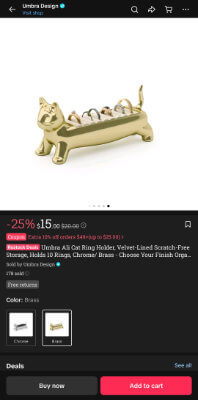
Not only does the app allow creators to sell products and users to buy those products, it allows creators to earn commissions by promoting those products.
So, not only can you promote your products in your own videos, you can also offer other creators commissions for promoting your products as well.
All of this has changed the landscape of TikTok as the entire app is currently littered with ads, but the changes are great for creators interested in selling products and diversifying their income streams.
TikTok product pages have the following elements:
- Image gallery
- Price with discount
- Short description
- Product variants
- Shipping estimates
- Reviews
- Long description
When you promote a product in a video, a yellow Shop button overlay appears on it. Users are now familiar enough with TikTok Shop to know what this button does.

Like I said, getting started with TikTok Shop is free. The cost comes from the fees the platform deducts from every sale you make.
They charge a commission fee and a transaction fee.
The transaction fee is a flat 3.78%, but the commission fee can range from 0% to 14.58% depending on what you’re selling and where you’re selling it at within the app (regular TikTok Shop, TikTok Marketplace or TikTok Mall).
Facebook and Instagram
Meta, the company that operates Facebook and Instagram, allows you to create a digital storefront you can use in each app.
You’ll be able to add products to your store, and users will be able to make purchases from it directly without leaving either app.
Unfortunately, product discovery is reliant on the same algorithm you rely on for content discovery. This is because these apps don’t have dedicated Shop sections users can browse like TikTok does.
Users will only be able to find your store by clicking a link to it in your post or on your profile page.
Facebook does have a tab for Facebook Marketplace, but this part of the app is more for peer-to-peer selling than retailer-to-customer selling.
Seller fees are a lot lower when you sell through Facebook and Instagram versus. You’ll be charged 2.9% for every sale if your customer paid by card, 3.49% if they paid via PayPal and 2.9% if they paid via Shop Pay by Shopify.
Link-in-bio page
A link-in-bio page is a simple webpage you set up to host links you can’t add to TikTok and Instagram posts.
Both of these apps only allow you to insert one custom link in your bio, so creators link to a simple bio page that contains every link they want to promote.
The creator then says, “link in bio” in their post, letting users know that if they follow the link, they’ll find a link to whatever the creator promoted.
There are a lot of tools like this out there, but Beacons, in particular, allows you to sell products on your bio page.
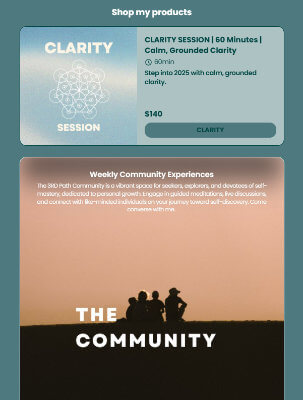
You can sell digital products, online courses and appointments, and you can even promote affiliate links in this way.
Beacons’ seller fee is 9% of every sale you make if you use a free account, but 0% if you use the tool’s premium version for $30/month.
2. Live shopping
Live shopping is available natively through social media apps that offer ecommerce features, including TikTok, Facebook and Instagram.
However, you can also sell products through a dedicated live shopping platform, like Whatnot.

Livestreaming has become very popular on social media apps, and with ecommerce features being integrated into social media apps, creators can promote products by showcasing them live.
This is highly engaging since viewers are able to ask questions and see how your product works in real time.
Whatnot generated more than $2 billion in gross merchandise value in 2024 alone. This demonstrates how lucrative live shopping has become.
Many creators stream to multiple platforms at the same time, so you can potentially host a live shopping stream through TikTok at the same time as you host one through Whatnot.
Like TikTok Shop, Whatnot charges a commission fee and a transaction fee.
The transaction fee is a fixed 2.9% + $0.30 on every sale you make.
The commission fee is a standard 8% in the United States and 6.67% + VAT in Europe but lowers to 4% for coins/money and 5% for electronics in the United States and 4% + VAT for coins/money in Europe.
3. Online marketplaces
Online marketplaces are built for ecommerce. You set up your own store on the marketplace, then list your products.
If that marketplace’s algorithm favors your products, it’ll show your listings for searches that are related to those products.
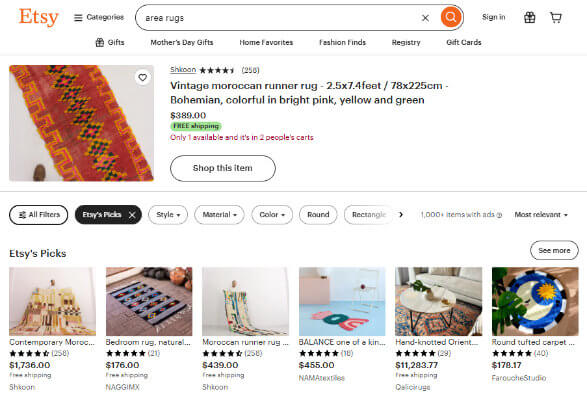
Marketplaces work in a similar way to TikTok Shop. You usually don’t have to pay to sell on these platforms, but the platforms will take commissions from each sale you make.
Here are some marketplaces you’re likely familiar with:
- Amazon
- Walmart
- eBay
- Etsy
- Poshmark
- Envato
- Creative Market
Some marketplaces, like Amazon, Walmart and eBay, are broad and allow you to sell just about anything.
Some are niche specific, such as Etsy, which is designed for handmade products, or Creative Market, which is designed for creative assets like fonts, images, website templates and icon sets.
4. Email list
Not all email marketing tools offer this feature, but some, including MailerLite, allow you to sell digital products directly in emails.
The tool allows you to create landing pages for individual products, which you can market in emails.
When a subscriber clicks on that email, they’ll be taken to the product’s landing page where they can read more about it and purchase it if they’re interested.
It’s a good compromise for creators who want to build their email lists from social media and also sell products but don’t want to host or build their own websites.
MailerLite’s landing page builder has over 30 content blocks for you to work with, which can insert and rearrange anywhere using the tool’s drag-and-drop builder.
As for fees, MailerLite charges for the number of email subscribers you have. Payments are collected via Stripe, so you only have to pay Stripe’s processing fee of 2.9% + $0.30 per sale.
Final thoughts
As I’m sure you’ll be aware of by now, you definitely can sell products without an online store.
Just remember that building your own store is super easy these days.
You can literally start your own store in like 5 minutes using Sellfy. They even have a free trial. Click here to try it for yourself.
So, that is something worth considering if you haven’t already.
But there is no right or wrong answer here. Some creators have built an entire business selling products without a store. Others have done the opposite.
The important thing is that you now know the advantages, disadvantages, and exactly how you can sell products without a store.
Then, you can make an informed decision.